





How to Remove Acne from Dry Skin? A Barrier-Safe Routine
 10 Oct 2026

Dealing with breakouts when your skin is already dry can feel like a skincare dilemma. You want to tackle acne, but harsh treatments can leave your skin feeling even drier, tighter, and more irritated. The good news? You can treat acne without compromising your skin barrier. The key is to combine a gentle cleanser, a moisturiser with barrier-supporting ingredients like ceramides, and an acne-fighting active that your skin can tolerate.
Consistency is just as important as choosing the right products. With a routine suited to dry, acne-prone skin, you may start noticing improvements within 4 to 8 weeks, although results can vary. In this guide, we’ll explore what causes acne on dry skin, which ingredients to look for, how to build a routine step by step, and when it may be time to seek professional advice.
Why dry skin can still get acne
Acne is not caused by oil alone. It develops when pores become blocked by dead skin cells and sebum, and inflammation follows. Dry skin can have a compromised barrier, which allows irritants in and moisture out. Acne-prone skin, even when dry, often shows increased water loss and lower levels of ceramides, the lipids that help seal the barrier.
When the barrier is weak, acne treatments that dry the skin can worsen irritation. The skin may feel tight, flaky, or sting, and adherence to treatment drops. This is why dermatologists increasingly recommend pairing acne actives with barrier-supportive skincare, especially for people who start with dry or sensitive skin.
The core principle: treat acne and repair the barrier together
A useful way to think about dry skin acne is “treat and support.” You still need an active that addresses clogged pores and inflammation. But you also need to give the skin the lipids and hydration it lacks. Skipping moisturiser to dry out pimples is counterproductive. The American Academy of Dermatology notes that when skin becomes dry, the body can make more oil, which may clog pores further. A non-comedogenic moisturiser helps break that cycle.
Step-by-step routine for acne-prone dry skin
Step 1: Use a gentle, creamy cleanser
Choose a low-pH, fragrance-free cleanser that does not foam heavily. Creamy or lotion cleansers are usually better for dry skin than gel or foaming washes. The Indian Association of Dermatologists, Venereologists and Leprologists advises a creamy, gentle cleanser for dry and sensitive skin. Wash with lukewarm water, not hot, and limit cleansing to twice a day and after sweating. Over-cleansing strips the barrier and makes dryness worse.
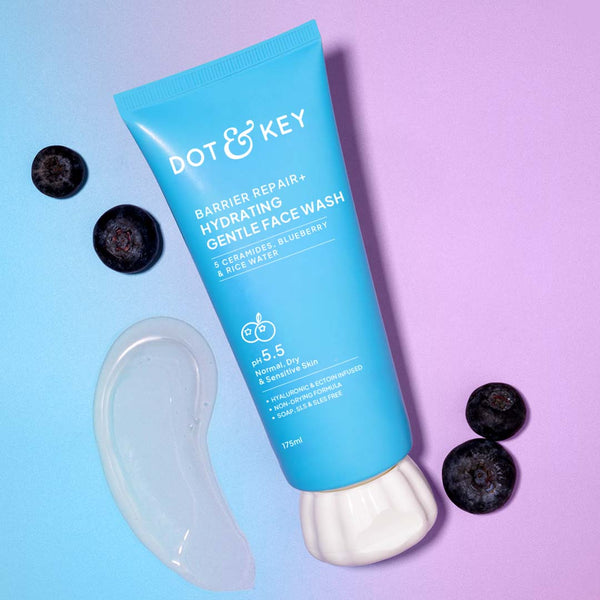
If you prefer a product designed for dry and sensitive skin, Dot & Key’s Barrier Repair Face Wash is formulated for normal, dry and sensitive skin. It is a cleanser option, not an acne treatment, so you would still need a separate active if acne is your concern.
Step 2: Apply a non-comedogenic moisturiser to damp skin
This is the most important step for dry skin acne. After patting your face dry, leave a little water on the skin and apply moisturiser immediately. This helps trap water in the skin. Look for a moisturiser labelled “non-comedogenic” or “won’t clog pores”.
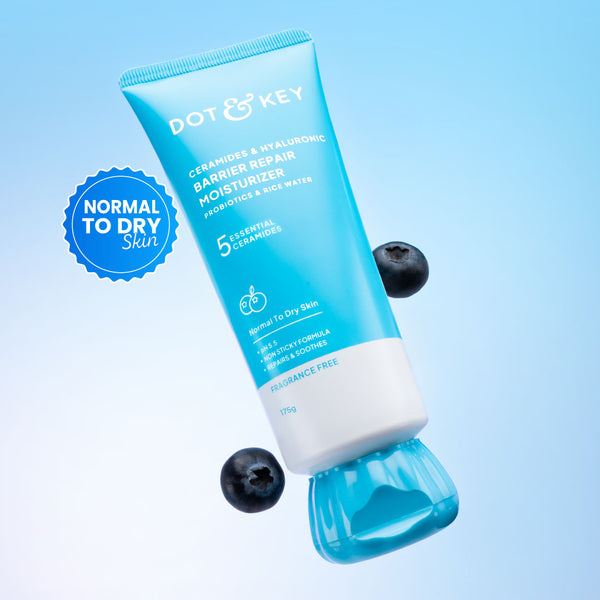
Ceramides are particularly useful. A ceramide-containing moisturiser can reduce water loss and improve tolerability of acne treatments. A ceramide-based regimen has been shown to support barrier function in acne-prone skin. Niacinamide is another helpful ingredient because it supports the barrier and can reduce redness; 2 to 4 percent concentrations are generally well tolerated. Hyaluronic acid and glycerin are humectants that draw water into the skin, while squalane or shea butter can add emollience without heavy occlusion. Avoid heavy creams with coconut oil or isopropyl myristate if you are prone to clogged pores.
Step 3: Introduce one acne active, slowly
For dry skin, the two most accessible over-the-counter acne actives are adapalene and salicylic acid. Adapalene is a retinoid that helps unclog pores and reduce inflammation. Salicylic acid is a beta hydroxy acid that exfoliates inside the pore. Both can dry the skin, so the goal is to use the lowest effective frequency and buffer with moisturiser.
Adapalene: Start with a pea-sized amount for the whole face, two or three nights a week. Apply it after moisturiser, not before, to reduce irritation. This is sometimes called the “moisturiser sandwich” method. Adapalene is generally considered the best-tolerated topical retinoid for starting treatment. Do not use it on broken or eczematous skin.
Salicylic acid: A leave-on salicylic acid product at 2 percent, used two or three times a week, may be enough. Some newer cleanser formulations with salicylic acid are designed to maintain barrier integrity, but leave-on products can still dry the skin. If your skin stings or flakes, reduce frequency.
Use only one new active at a time. Give your skin four to six weeks to adjust before adding another. Benzoyl peroxide can be very drying and is harder to tolerate on dry skin; if a dermatologist recommends it, use it as a short-contact wash rather than a leave-on treatment.
Step 4: Protect with sunscreen every morning
Sun exposure can worsen post-inflammatory hyperpigmentation, the dark marks left after acne. A broad-spectrum sunscreen with SPF 30 or higher helps prevent these marks from deepening. Choose a non-comedogenic, fragrance-free sunscreen. Gel or fluid textures are often better tolerated in Indian humidity, while a slightly richer cream may suit drier winter months.
Adapalene vs salicylic acid for dry skin: a practical comparison
|
Feature |
Adapalene |
Salicylic acid |
|
How it works |
Retinoid; normalises pore lining and reduces inflammation |
Beta hydroxy acid; exfoliates dead skin cells inside the pore |
|
Best for |
Mild to moderate acne, including blackheads and whiteheads |
Blackheads, whiteheads, and mild inflammatory acne |
|
Drying potential |
Moderate; tolerability improves with buffering |
Moderate; depends on formulation and frequency |
|
How to start on dry skin |
Pea-sized amount, 2–3 nights per week, after moisturiser |
2% leave-on, 2–3 times per week, or a short-contact wash |
|
Key precaution |
Use sunscreen daily; avoid if pregnant or breastfeeding without medical advice |
Avoid if allergic to aspirin; do not combine with other exfoliating acids on the same night |
How long results take and what affects them
Acne improvement is gradual. Most studies show visible reduction in lesions after four to eight weeks of consistent use of an acne-friendly routine. Dryness and irritation from actives often peak in the first two to four weeks and then settle as the skin adjusts. Factors that slow progress include inconsistent use, over-cleansing, skipping moisturiser, and adding too many actives at once. Indian humidity can help hydration in some seasons, but sweat and occlusion can also contribute to breakouts; adjust moisturiser texture rather than abandoning it.
Common mistakes that make dry skin acne worse
• Skipping moisturiser to dry out pimples. This weakens the barrier and can trigger more oil production.
• Using harsh scrubs or alcohol-based toners. These irritate the skin and do not treat the underlying cause of acne.
• Applying adapalene or salicylic acid every night from day one. Start two or three nights a week and build up.
• Layering multiple actives in the same routine. This increases the risk of irritation without necessarily improving results.
• Cleansing more than twice a day. Over-washing strips the barrier.
• Stopping treatment once skin clears. Acne maintenance is often needed; discuss a maintenance plan with a dermatologist.
When to see a dermatologist
See a dermatologist if your acne is severe, painful, or leaving scars; if it is not improving after eight to twelve weeks of consistent over-the-counter treatment; if you have signs of hormonal acne such as deep jawline cysts; or if you are pregnant or planning pregnancy and need advice on safe actives. A dermatologist can prescribe alternatives such as azelaic acid, topical antibiotics, or hormonal treatments when appropriate.
FAQ
Can dry skin cause acne?
Dry skin does not directly cause acne, but a weakened barrier can make the skin more reactive and may contribute to inflammation. Acne can develop in dry skin, and acne treatments can further dry the skin.
Should I use a moisturiser if I have acne?
Yes, especially if your skin feels dry or tight. A non-comedogenic moisturiser helps maintain the barrier and can improve tolerance of acne treatments.
Can I use salicylic acid on dry skin?
Yes, but start with a low frequency, such as two or three times a week, and use a non-comedogenic moisturiser alongside it. If stinging or flaking occurs, reduce frequency.
Is adapalene safe for dry skin?
Adapalene is generally the best-tolerated topical retinoid, but it can still dry the skin. Apply it after moisturiser, two or three nights a week, and increase frequency only when the skin feels comfortable.
How do I prevent dark marks from acne on dry skin?
Daily broad-spectrum sunscreen with SPF 30 or higher is essential. Niacinamide and vitamin C derivatives may also help fade post-inflammatory hyperpigmentation, but sunscreen is the foundation.
Can I use a hydrating cleanser and an acne cleanser together?
It is better to use one gentle cleanser and a separate leave-on acne active. Using two medicated cleansers can over-dry the skin.