




Which Sunscreen Is Best for Swimming? Water-Resistant Protection
 04 Aug 2026

Swimming, pool days, and beach trips make sunscreen even more important—but not every sunscreen is designed to handle prolonged water exposure. The best sunscreen for swimming is a broad-spectrum, water-resistant formula with SPF 50 or higher that can maintain its protective film for longer when exposed to water and sweat.
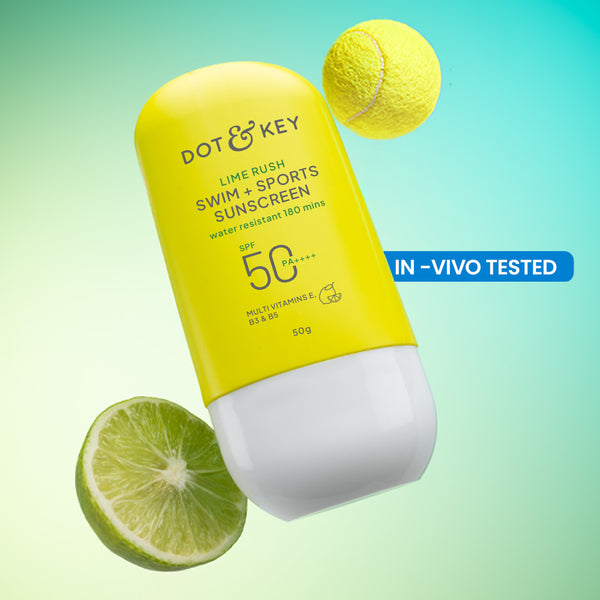
If you're spending extended time in the pool, taking a sea dip, or enjoying outdoor water activities under the Indian sun, choosing a sunscreen specifically formulated for active use can make a meaningful difference. A water-resistant formula such as Dot & Key Swim + Sports Sunscreen is designed to provide long-lasting protection during water-based activities.
But water resistance doesn't mean waterproof. Even the most durable sunscreen needs to be reapplied after swimming, towel drying, or excessive sweating. The key is choosing the right formula, applying enough of it, and knowing when to reapply.
In this guide, we'll explain what makes a sunscreen water-resistant, how long that protection lasts, what to look for when choosing a sunscreen for swimming, and how to apply and reapply it correctly for reliable sun protection.
Why Regular Sunscreen Fails in Water
Everyday sunscreens can provide excellent UV protection during normal daily activities, but prolonged exposure to water can affect the sunscreen film on your skin. Swimming, sweating, and towel drying can gradually remove or disrupt the protective layer, potentially leaving parts of your skin less protected.
This is particularly important during outdoor swimming because water does not protect you from UV radiation. In fact, reflected sunlight from surfaces such as water can increase your overall exposure.
A water-resistant sunscreen is formulated to help the protective film stay on the skin for longer during water or sweat exposure. However, it isn't completely immune to removal. Over time, swimming and towel drying can still reduce coverage.
That's why a high SPF number alone isn't enough for a swimming sunscreen. Look for a formula that combines:
• Broad-spectrum protection against UVA and UVB rays
• SPF 50 or higher for strong UVB protection
• Water resistance for better performance during swimming and sweating
• A comfortable, durable film that stays evenly distributed on the skin
• Clear reapplication instructions, especially after water exposure
Most importantly, don't interpret “water-resistant” as “waterproof.” Sunscreen should always be reapplied after swimming or towel drying, even when the product is labeled water-resistant.
What Makes a Sunscreen Suitable for Swimming
To work during swimming, a sunscreen must be formulated to cling to the skin even when you are continuously wet. There are four non-negotiable qualities.
Water Resistance Explained
Water-resistant sunscreen has undergone specific testing (usually based on international standards like those from the FDA or EU Cosmetics Regulation) to prove that it maintains its labelled SPF after a certain period of water immersion. It does not mean “waterproof”—no sunscreen can ever be completely waterproof—but it does mean the formula has been designed to resist wash-off far longer than a non-resistant product.
SPF and PA Rating Essentials
For swimming, choose SPF 30 as the absolute minimum. In reality, SPF 50 is strongly recommended, especially in India where UV intensity can be extreme. The PA rating tells you about UVA protection—the rays that cause tanning, pigmentation, and long-term skin damage. PA++++ (the highest level commonly available) offers the most comprehensive UVA defence and is ideal for outdoor swimming.
Broad-Spectrum Requirement
A sunscreen must clearly state “broad-spectrum” or show both UVA and UVB symbols. UVB causes sunburn, but UVA penetrates deeper, contributing to tanning and premature ageing. In water, where UV rays reflect off the surface, your exposure increases, so broad-spectrum coverage is vital.
Texture and Wearability in Water
A swimming sunscreen should feel comfortable and stay put without dripping into your eyes, feeling excessively greasy, or leaving a white cast. Lightweight, fast-absorbing gel or lotion-gel hybrids tend to perform better because they form a uniform film that moves with the skin.
Understanding Water Resistance Durations: 40, 80, and 180 Minutes
Water resistance claims are not random. They are based on controlled immersion tests that replicate swimming conditions. Here is what each label means in practice.
|
Claim |
What It Means |
Best For |
|
40 minutes water resistant |
Maintains SPF after 40 minutes of water activity |
Short dips, light water exposure |
|
80 minutes water resistant |
Maintains SPF after 80 minutes of water activity |
Moderate swimming, water sports |
|
180 minutes water resistant |
Maintains SPF after 180 minutes of water activity (brand-tested) |
Extended swimming, long beach days, serious swimmers |
Standard benchmarks are 40 and 80 minutes, as per commonly accepted testing protocols. Some brands, including Dot & Key, invest in extended testing to offer 180-minute water resistance. This means the sunscreen film remains protective for significantly longer before reapplication is needed—provided you do not towel off or rub the skin aggressively.
Key Features to Look for in a Swimming Sunscreen
When you are choosing a sunscreen specifically for swimming, prioritise these attributes:
• Broad-spectrum SPF 50 and PA++++: non-negotiable for high-exposure water activities.
• Long water resistance: ideally 80 minutes or more; 180 minutes if you plan extended swimming sessions.
• Sweat-resistant: important because swimming in India often means heat and humidity even outside the water.
• Lightweight, non-greasy finish: reduces the unpleasant slick feel that can make you want to wash it off.
• No white cast: especially relevant for Indian skin tones.
• Non-comedogenic: so it does not clog pores during prolonged wear in humid, sweaty conditions.
The Ideal Sunscreen for Swimming
If you are looking for a single product that meets every critical requirement for swimming:
What it offers
• Extended water resistance: the brand states that it maintains protection for up to 180 minutes of continuous water exposure, covering long swim sessions without the need to cut your time short for reapplication.
• High-level broad-spectrum defence: it is formulated with SPF 50 and a high PA rating (the product packaging indicates PA++++; please verify final label details) to shield against both UVB-induced sunburn and UVA-driven tanning and photoageing.
• A lightweight, breathable texture that feels comfortable even in humid conditions—no heavy, sticky residue. It absorbs quickly and is designed not to drip into your eyes.
• Sweat and water resistance combined, making it equally suitable for pool swimming, open-water swims, beach volleyball, or any outdoor activity where you are sweating and getting wet.
Who it suits
The formula is developed to be gentle and non-comedogenic, so it can be used by all skin types. Even those with oily or combination skin can benefit, because the texture avoids a greasy feel and the sunscreen is designed to stay put without clogging pores. Dry skin types will find it non-drying, and sensitive skin users should patch-test as with any new product.
How to use it
Apply a generous, even layer to all exposed skin 15 to 20 minutes before entering the water. Reapply after 180 minutes of continuous swimming, or immediately after towelling off, heavy sweating, or rubbing the skin. Following this routine ensures sustained protection.
Editorial note: Always confirm the exact SPF, PA rating, and water resistance test standard from the final product label. The information provided here reflects the product as intended by the brand.
How to Apply Sunscreen Before Swimming (Step-by-Step)
Correct application is what turns a good sunscreen into effective protection. Follow these steps before every swim.
1. Start with clean, dry skin. If you already have a layer of sweat or old sunscreen, wash it off first.
2. Take enough product. For the face and neck, use about half a teaspoon; for the body, roughly a shot glass amount (30 ml) is recommended. Under-application is one of the biggest reasons sunscreen fails.
3. Dot and spread evenly. Apply small dots all over and gently spread without rubbing aggressively. You want a uniform film, not a scrubbed-in layer.
4. Wait 15 to 20 minutes before getting into the water. This allows the sunscreen to bind properly to the skin and form its protective film. If you jump in immediately, you risk washing off a significant portion.
5. Pay attention to easily missed areas: ears, back of the neck, tops of feet, behind the knees, and the part line on your scalp if your hair is not covered.
Reapplication After Swimming: When and How
Water-resistant does not mean reapplication-free. These rules keep you protected.
• After the water-resistance window expires: For an 80-minute sunscreen, reapply every 80 minutes of swimming. For the 180-minute formula, you can go up to 180 minutes, but not beyond.
• Immediately after towelling off: Rubbing with a towel removes both water and sunscreen. Always reapply right after drying yourself.
• After heavy sweating or wiping your face: Even outside the water, moisture and friction compromise the film.
• As a general habit: If you are unsure, reapply every two hours or sooner. It is safer to over-apply than to let protection lapse.
When reapplying, gently pat skin dry without rubbing, then apply a fresh layer as you did initially.
Common Mistakes to Avoid When Using Sunscreen for Swimming
• Using a non-water-resistant sunscreen and assuming it will last.
• Applying right before jumping in – the sunscreen needs time to set.
• Applying too little – a thin layer delivers far lower SPF than the label promises.
• Relying on “waterproof” products – no product is truly waterproof; all water-resistant sunscreens eventually need reapplication.
• Forgetting to reapply after towelling – even the most durable formula lifts away with friction.
• Ignoring cloud cover or cooler weather – UV rays penetrate clouds and reflect off water, so protection is still essential.
Swimming Sunscreen for Different Skin Types
The right texture and finish matter, especially when you will be in and out of water for hours.
• Oily and acne-prone skin: Look for a lightweight, non-comedogenic, water-resistant sunscreen that does not feel occlusive.
• Dry skin: Your skin still needs a water-resistant film. Look for a formula that does not strip moisture.
• Combination skin: A balanced, non-sticky texture works well, and you can focus blotting on the T-zone if needed after swimming.
• Sensitive skin: Always patch-test. The absence of added fragrance and the use of gentle film formers can make the sunscreen a reasonable option, but individual responses vary.
Post-Swim Skincare Routine
What you do after swimming affects both your skin health and how your tan or sun damage concerns evolve.
• Rinse off chlorine or salt immediately. Use fresh water and a gentle cleanser to remove all sunscreen residue, sweat, and pool chemicals.
• Use a mild, hydrating face wash and body wash. Avoid harsh scrubbing right after sun exposure.
• Pat dry – do not rub.
• Apply a soothing moisturiser to replenish hydration. If you have been in the sun for a long time, an aloe vera-based or lightweight gel moisturiser can calm the skin.
• If you plan to stay outdoors, reapply sunscreen (your regular daily sunscreen is fine now if you are not going back into water).
• For those concerned about tanning, follow up your evening routine with a brightening product containing ingredients like vitamin C or niacinamide, but be gentle and do not combine too many actives on the same day.
The Takeaway
The best sunscreen for swimming is always a water-resistant, broad-spectrum formula with a high SPF and strong UVA protection. For Indian swimmers, the Dot & Key 180-Minute Water-Resistant Sunscreen delivers exactly that, with an extended water-resistance claim that supports long, carefree hours in the pool or sea. Pair it with correct application and timely reapplication, and you have a straightforward, reliable way to enjoy the water without compromising your skin’s health.
Frequently Asked Questions
Is SPF 50 enough for swimming, or do I need more?
SPF 50 blocks approximately 98% of UVB rays when applied correctly, which is sufficient for swimming when combined with high UVA protection (PA++++) and proper reapplication. No sunscreen blocks 100% of UV rays, but SPF 50 offers excellent defence.
Can I use a regular sunscreen and just reapply often while swimming?
This is not reliable. Regular sunscreens begin to wash off within minutes, so by the time you reapply, your skin has already been exposed. A water-resistant formula is essential for any significant time in water.
Will this sunscreen leave a white cast on Indian skin?
The 180-Minute Water-Resistant Sunscreen is formulated to be lightweight and absorb without a chalky residue. Individual experiences may vary, but it is designed to avoid the white cast commonly associated with mineral-heavy sunscreens.
Can I use the same sunscreen for my face and body while swimming?
Yes, provided the product is labelled safe for facial use. Most of the water-resistant sunscreens are suitable for both face and body, making it convenient for swimming.
Does chlorine or salt water affect the sunscreen’s performance?
Water-resistant sunscreens are tested under conditions that simulate immersion in water; they are designed to maintain protection in both chlorinated pools and salt water. Friction and towelling are bigger threats to the protective film than the type of water itself.
What if I swim for less than 180 minutes – do I still need to reapply after getting out?
If you towel dry, yes. If you get out and air-dry without any rubbing, and you have not exceeded the 180-minute window, the film may still be intact. However, as a general rule, reapplying after a swim is a safe practice.